Bern by Train
Six kilometers of arcades, a clock with an hourly show, bears by the river, and the flat where Einstein rewrote physics.
The short version
- Intercity trains run Zurich–Bern about every half hour, taking roughly an hour — times at sbb.ch. The old town starts five minutes from the station.
- Bern’s medieval centre — UNESCO-listed whole since 1983 — rides a peninsula in the Aare’s bend, with over six kilometers of covered arcades that make it Europe’s best city for sightseeing in the rain.
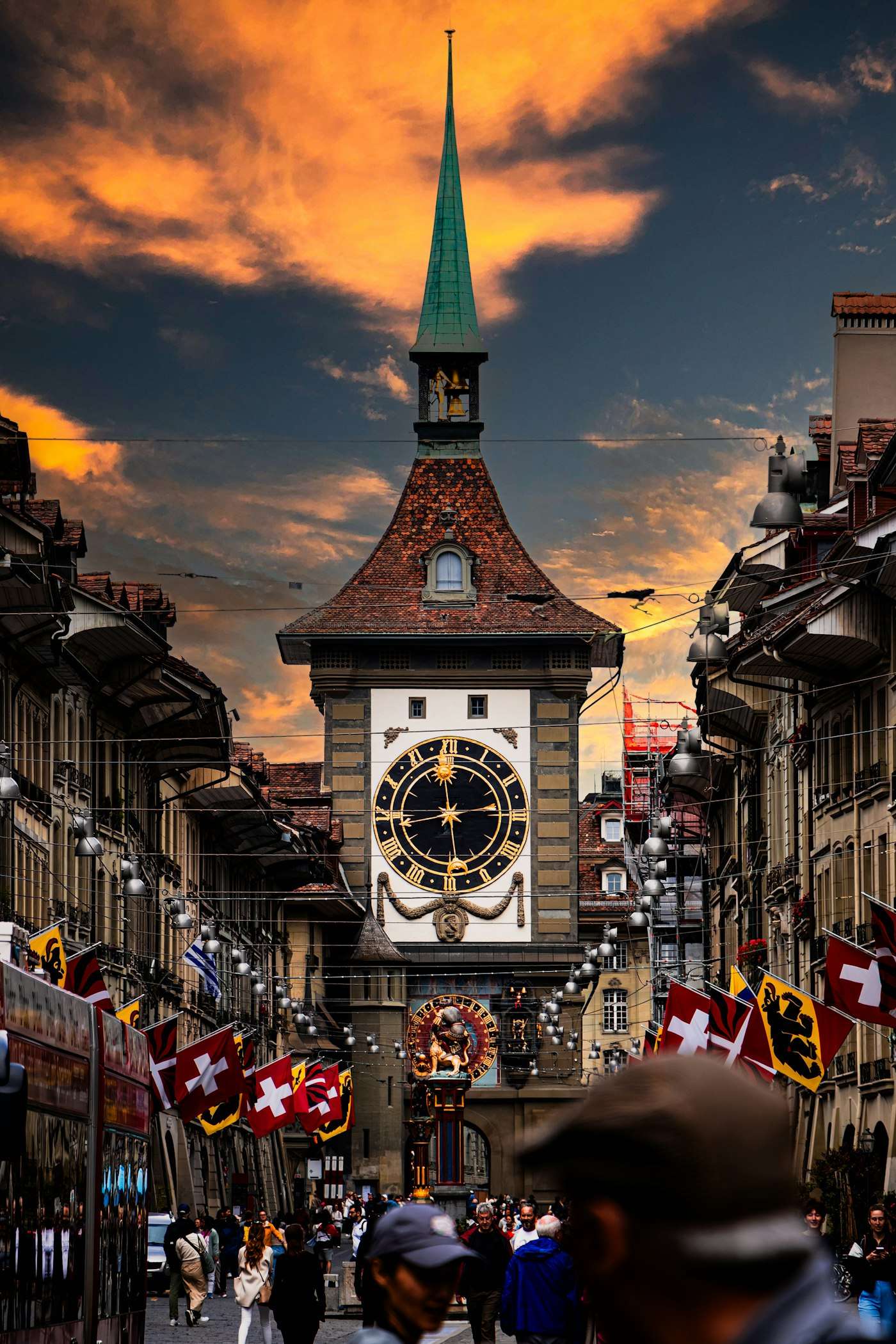
- The Zytglogge has kept time since the 1530s with its astronomical face and mechanical theatre — jesters, roosters, and marching bears perform in the minutes before each hour, and interior tours climb to the works; city info at bern.com.
- Einstein lived at Kramgasse 49 from 1903 to 1905 — the flat where the miracle-year papers took shape is a small museum, and the arcades below still sell the coffee that fueled them.
- The Bear Park keeps Bern’s heraldic animals — brown bears, kept by the city in one form or another since 1513 — in a riverside enclosure below the Nydegg bridge, free to view; the Rosengarten above it holds the classic postcard panorama.

Getting there
Intercity trains leave Zürich HB for Bern every half hour and take about an hour — no reservations needed, and the Swiss Travel Pass covers it. Bern’s station opens directly onto the old town’s upper end: walk down Spitalgasse and the arcades take over. Everything — clock, Einstein flat, cathedral, Bear Park — lines up along one gentle downhill kilometer to the river, with buses back up for the return-averse.
The day
Walk the spine of the old town downhill — Spitalgasse to Marktgasse to Kramgasse — under arcades that have covered shoppers since the Middle Ages, past eleven Renaissance fountains whose painted figures include an ogre eating children (the Kindlifresser, cheerfully unexplained for five centuries). Catch the Zytglogge’s pre-hour performance, then ring Einstein’s doorbell at Kramgasse 49: the little flat upstairs is where a patent clerk, aged 26, produced special relativity and E=mc² between shifts — the museum keeps it modest, which is the power of it. The Münster’s tower — Switzerland’s tallest — repays its steps with the Aare’s uncanny glacier-green bend below. Cross the Nydegg bridge to the Bear Park, where the city’s namesakes amble a riverside slope, and climb to the Rosengarten for the full red-roofed panorama. Descend for a swim-watch: locals float the Aare through the city all summer, commuting by current. The Bundeshaus terrace and a last arcade coffee close the loop uphill to the station.
When to go
Year-round — six kilometers of arcades make Bern the rare city improved by rain, and the museums and clock ignore seasons. Summer adds the Aare swimmers and terrace life; December, one of Switzerland’s best Christmas markets under the arcades. The Rosengarten’s cherry blossoms in April and the onion market madness of Zibelemärit in late November are the local calendar’s poles.
Frequently Asked Questions
How do you get from Zurich to Bern?
Intercity train, every half hour, about an hour. The old town begins five minutes from Bern’s station, and the whole sightseeing spine is one walkable kilometer downhill to the river.
What is the Zytglogge show?
In the four minutes before each hour, the 16th-century clock’s figures perform — the jester jangles, the rooster crows, bears march, and Chronos turns his hourglass — before the hour strikes. Guided tours climb inside to the medieval machinery. Arrive early; it waits for no one.
What is in the Einstein House?
The Kramgasse 49 flat where Einstein lived from 1903 to 1905 with Mileva and baby Hans Albert — period-furnished rooms and the story of the annus mirabilis he produced there as a patent clerk. Small, cheap, and quietly staggering.
Are the bears worth seeing?
The Bear Park is a free riverside enclosure below the old town where Bern’s heraldic brown bears live — the city has kept bears since 1513, and the modern park replaced the old pits with a hillside by the Aare. Combine it with the Rosengarten climb for the view.
Why is the Aare so green?
Glacier flour — fine rock dust from the Alps keeps the river that uncanny turquoise. In summer, locals swim the current through the city as public transport with better views; watching from the Münster platform is participation enough for most visitors.