Zurich Day Tours
Bonjour! I’m Maud, your day trip expert. Ask me anything — where to go, how to get there, and what’s actually worth your day.
Zurich runs the most efficient day-trip network in Europe, which is the least surprising sentence ever written about Switzerland: Europe’s largest waterfall is under an hour by train, the mountain that invented mountain tourism combines boat and cogwheel into one ticket, and Lucerne’s wooden bridge is forty-five minutes away with the Alps arranged behind it.
The sortings below include the Jungfraujoch question — the “Top of Europe” that day-trip marketing loves and arithmetic doesn’t — and the Liechtenstein novelty, priced per passport stamp. The city block covers the river-swimming institution nobody warns you about.
Here’s what’s worth a day, with real times and honest trade-offs.
Popular Day Trips
Rhine Falls
Free Falls, a Five-Franc Deck
Lucerne
The 45-Minute Train, the Chapel Bridge
Appenzell
The Shrinking Train, the Cliff Inn Photograph
Stein am Rhein
The Painted Square, the First Wakker Prize
Lucerne & Pilatus — The Postcard and the Golden Round Trip
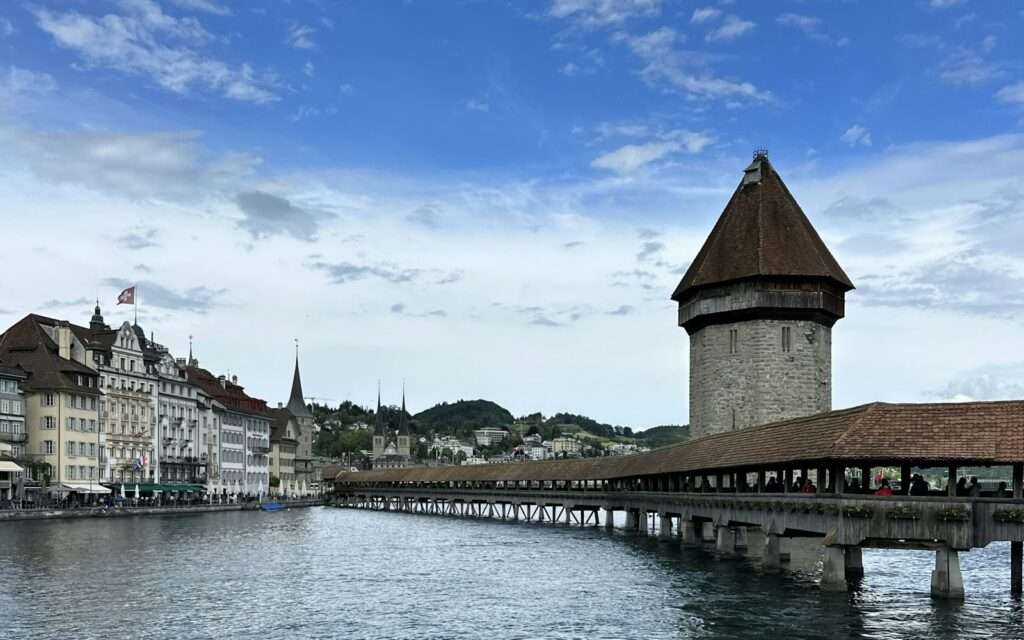
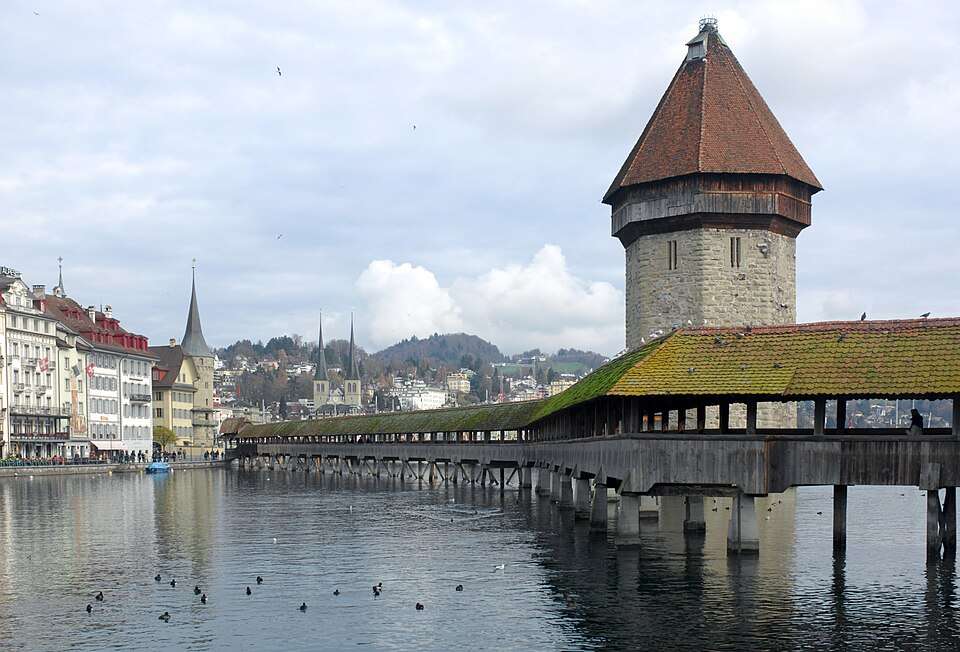
Forty-five minutes southwest, Lucerne is the Switzerland everyone pictured: the Chapel Bridge’s flowered diagonal across the Reuss (rebuilt faithfully after the 1993 fire, and honest about it), the painted facades of the old squares, the Lion Monument — Twain’s “saddest stone” — and the lake opening to genuine Alps at the promenade’s end.
The town takes a half day; the mountain completes it. Pilatus, the craggy hulk above the lake, runs the “Golden Round Trip” in season: boat from Lucerne to Alpnachstad, up the world’s steepest cogwheel railway (48% gradient, and it feels it), the summit’s dragon-legend terraces at 2,132 meters, then down the other side by aerial cableway and gondola to Kriens and the bus back. The loop is the whole point — book it as the package, ride the boat leg outbound, and check operating season (the cogwheel typically runs roughly May to November; the cableway side runs year-round).
Fine-weather demand queues the summit legs in July–August, so start on the early boat; the Verkehrshaus (Swiss Museum of Transport) back in Lucerne is the rainy-day insurance and excellent; and the town’s watch-shop economy prices for exactly who it thinks you are. This is the region’s essential first day out.
Read the full Lucerne day-trip page.
Rigi — The Queen of the Mountains
Rigi is the gentler royal: the free-standing massif between three lakes that invented mountain tourism — Europe’s first mountain railway climbed it in 1871, and Turner painted it obsessively from the shore. The classic format remains the best: boat from Lucerne across the lake to Vitznau, the red cogwheel train to Rigi Kulm at 1,798 meters, the summit panorama of lakes and Alps in a 360-degree sweep, then down the Goldau side or via the Weggis cable car for the loop.
The mechanics: the Rigi day pass covers all the mountain’s railways and cableways — cog trains from both Vitznau and Goldau plus the Weggis and Kräbel cable cars — and children up to 15 ride free with an adult, which quietly makes Rigi the best family-value mountain in the country. Combination tickets fold the lake boat in; the boat leg is half the trip and shouldn’t be skipped.
The upgrades: the Rigi Kaltbad mineral baths let you soak at 1,400 meters facing the lake (swimsuit in the daypack), the ridge walks between stations are stroller-grade and panoramic, and winter converts the mountain into a sledding-and-winter-hiking hill above the fog line — the sea-of-fog days, when the summit floats above a white ocean, are the connoisseur’s Rigi. Full day, zero stress, and the honest pick over Pilatus for families and view-collectors.
The Rhine Falls & Stein am Rhein — Water and Painted Walls
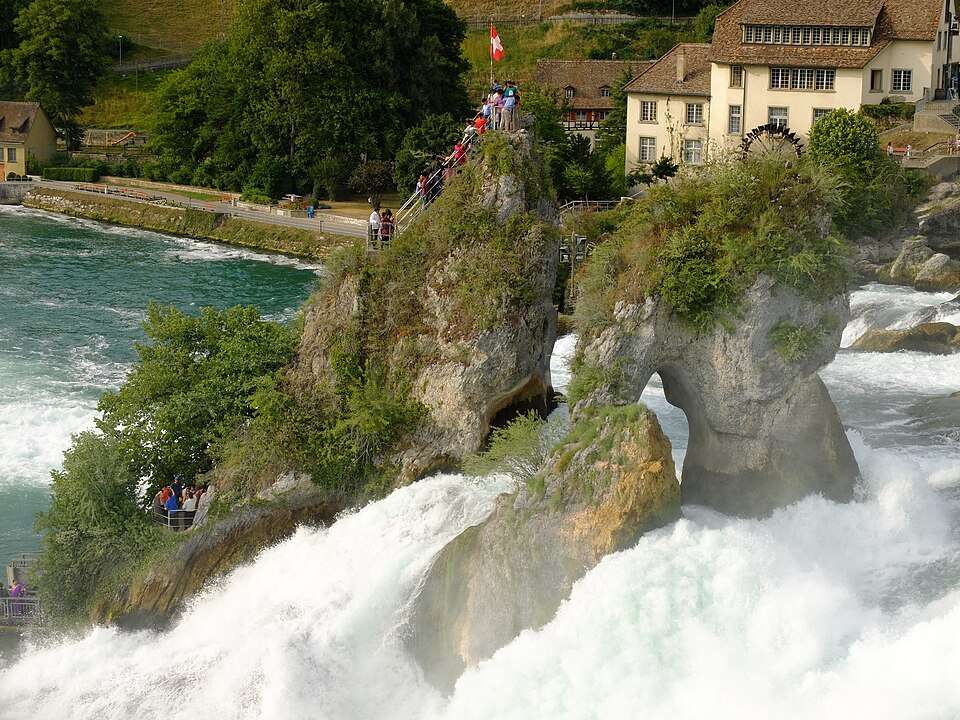
Under an hour north by train, the Rhine Falls are Europe’s largest waterfall by volume: 150 meters wide, 23 high, and in early summer moving up to 600 cubic meters a second — numbers that undersell the physical fact of standing beside it. The mechanics: the falls themselves are freely accessible year-round — the north bank at Schlössli Wörth costs nothing, while the south bank at Schloss Laufen charges about CHF 5 for the platforms that hang directly over the water (worth it) plus the Historama exhibit. Trains from Zurich serve both banks: Neuhausen Rheinfall for the north, Schloss Laufen am Rheinfall for the south.
The boats run roughly April through mid-October, and the one to take is the Rock trip: it lands you on the Rheinfallfelsen — the rock in the middle of the falls — where a staircase climbs to a platform inside the spray. Short round trips and bank crossings serve the time-pressed; the rail-bridge footpath above the falls gives the free third angle.
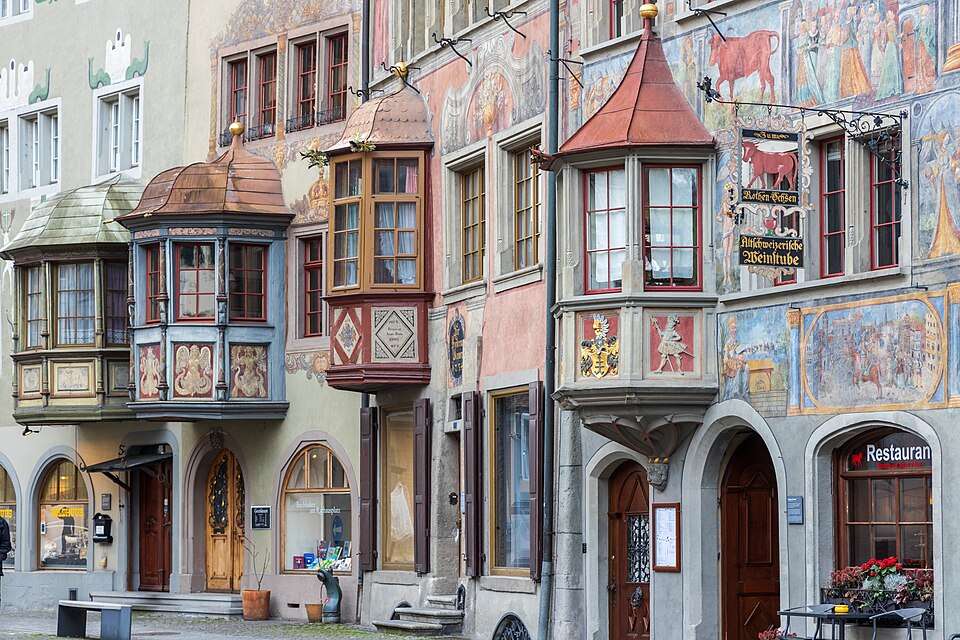
Stein am Rhein, twenty minutes upstream, completes the day: the small town whose square is wall-to-wall painted Renaissance facades — the best-preserved ensemble in Switzerland — with the Hohenklingen castle above for the view and the riverside terraces for lunch. The pairing runs a comfortable single day by rail, and April–June brings the falls at maximum thunder.
Read the full Rhine Falls day-trip page.
Read the full Stein am Rhein day-trip page.
Appenzell & Säntis — The Deep-Tradition East
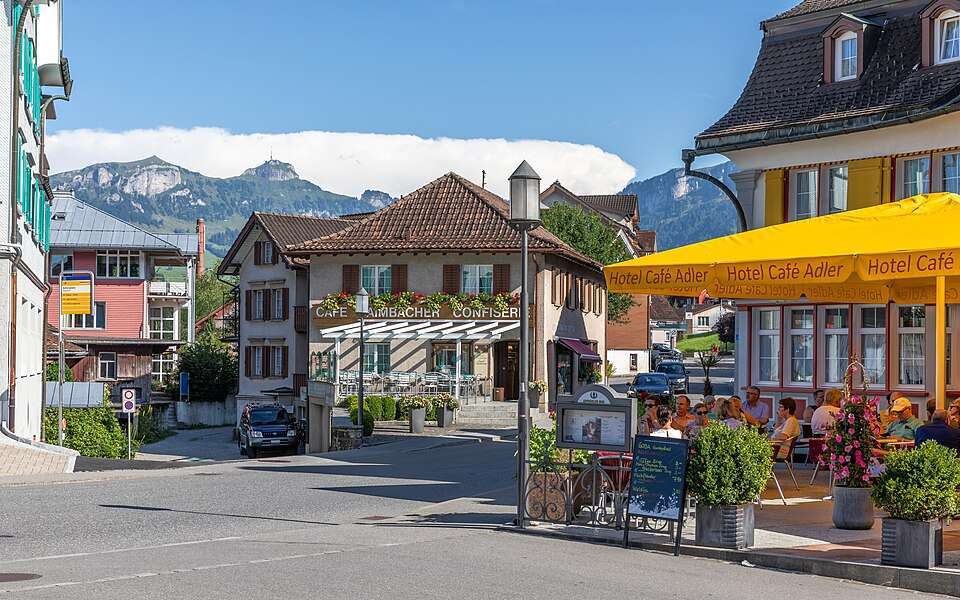
Ninety minutes east, Appenzell is the Switzerland that tourism posters borrow and the region never stopped living: a car-light village of painted gabled houses, a main street of cheese cellars and calf-leather craft shops, and a culture — hand-raised voting on the square until remarkably recently, herders’ festivals, dialect pride — worn without performance.
The circuit: the village itself (the Appenzeller cheese story told at the show dairy in nearby Stein, samples included and the secret brine recipe intact), then altitude by taste. Säntis, the region’s 2,502-meter landmark, lifts by cable car from Schwägalp to a summit claiming six countries on the clearest days. The gentler icon is Ebenalp: the cable car to the cliff-top, the walk down through the Wildkirchli caves where hermits lived, and the Aescher — the guesthouse pressed flat against the cliff face that became one of the most photographed buildings in the Alps. Continue down to the Seealpsee’s mirror lake for the full classic loop, real shoes required.
This is the long-but-gentle culture day — trains and cable cars do the work — and the eastern light and lower coach density make it the connoisseur’s alternative to the Lucerne axis. Biberli pastry for the train home is the rule.
Read the full Appenzell day-trip page.
The Jungfraujoch Question & Liechtenstein — Two Honest Verdicts
Two trips sell hard from Zurich and get plain arithmetic here.
Jungfraujoch, the “Top of Europe”: the rail journey to the 3,454-meter saddle is a genuine engineering marvel with a genuine glacier panorama — and from Zurich it’s two-plus hours each way before the mountain railways even begin, stacking toward a twelve-hour day of which the majority is transit, at one of the highest ticket prices in world tourism. The verdict: from Zurich as a day trip, it’s the expensive tail wagging a long dog — travelers based in Interlaken or Grindelwald should absolutely go; Zurich-based travelers get more mountain per hour and franc from Rigi, Pilatus, or Säntis, or should give the Bernese Oberland the overnight it deserves. Grindelwald First’s cliff walk makes the honest half-price alternative if the Oberland calls anyway.
Liechtenstein: the principality sits ninety minutes away. Vaduz is a tidy half day — the castle above town (the prince’s residence, exterior only), the art museum’s black cube, the philatelic museum for the stamp heritage, and the souvenir passport stamp at the tourist office for a few francs, which is the honest emblem of the whole visit. The verdict: charming as a novelty and a checklist entry, thin as a full day — pair it with the Heidi country around Maienfeld or the drive up to Malbun’s alpine bowl, or take it as the halfway stop en route to Appenzell.
The River Baths, the Old Town & Zurich Itself
The institution first: in summer, Zurich swims. The badis — river and lake baths — are the city’s real social calendar: Frauenbadi (women only by day, bar for all by night) and Männerbadi on the Limmat, Seebad Enge on the lake, and the Oberer Letten stretch where locals float the river current after work with their clothes in a dry bag. Joining in is the single most local thing a visitor can do, and the water is drinking-quality clean.
The classic circuit: the Niederdorf’s old-town lanes, Grossmünster’s towers (climb one) facing Fraumünster’s Chagall windows across the river, Lindenhof’s plane-tree terrace over the rooftops, and Bahnhofstrasse walked for the spectacle of window prices rather than the shopping. The Kunsthaus holds the heavyweight collection (Giacometti at depth); the FIFA Museum and the Lindt Home of Chocolate (book the slot; the fountain is real) cover the special interests.
The eating rules: Zürigeschnetzeltes with rösti once, properly; sausage-and-bürli from Sternen Grill standing up; Luxemburgerli from Sprüngli as the portable ritual; and fondue in winter without apology. The honesty: Zurich is expensive at Swiss scale — the badi picnic, the Migros/Coop lunch counters, and the tap water (always free, always excellent) are the tools. Season math: June–September runs the lake life and every mountain above; December’s Christmas markets and the Singing Christmas Tree own the winter; and February’s Fasnacht is Lucerne’s, worth timing the Lucerne day to deliberately.
Frequently Asked Questions
What’s the best mountain day trip from Zurich?
Rigi for the classic boat-and-cogwheel loop with a family-free-kids day pass; Pilatus for the steeper drama and the Golden Round Trip. Both run from Lucerne, both want the early boat, and both beat distant Jungfraujoch on time and cost from a Zurich base.
Do the Rhine Falls cost anything?
The falls are free year-round — the north bank costs nothing, the south-bank castle platforms run about CHF 5 and are worth it. Boats sail roughly April to mid-October; take the Rock trip to the staircase in the middle of the falls.
Is Jungfraujoch worth it from Zurich?
As a day trip, honestly no — two-plus hours each way before the mountain trains, at a premium price, makes a twelve-hour transit-heavy day. Go from an Interlaken or Grindelwald base, or take Rigi, Pilatus, or Säntis from Zurich instead.
Is Liechtenstein worth visiting?
As a half-day novelty, cheerfully yes — Vaduz castle from below, the art museum, and the souvenir passport stamp. Pair it with Heidi country or Malbun, or fold it into the drive east; it’s thin as a standalone full day.
What should you not miss in Zurich itself?
Summer’s badi culture — swim the Limmat or lake baths like a local — plus Fraumünster’s Chagall windows, the Lindenhof terrace, and Luxemburgerli from Sprüngli. The river float with a dry bag is the city’s true initiation.